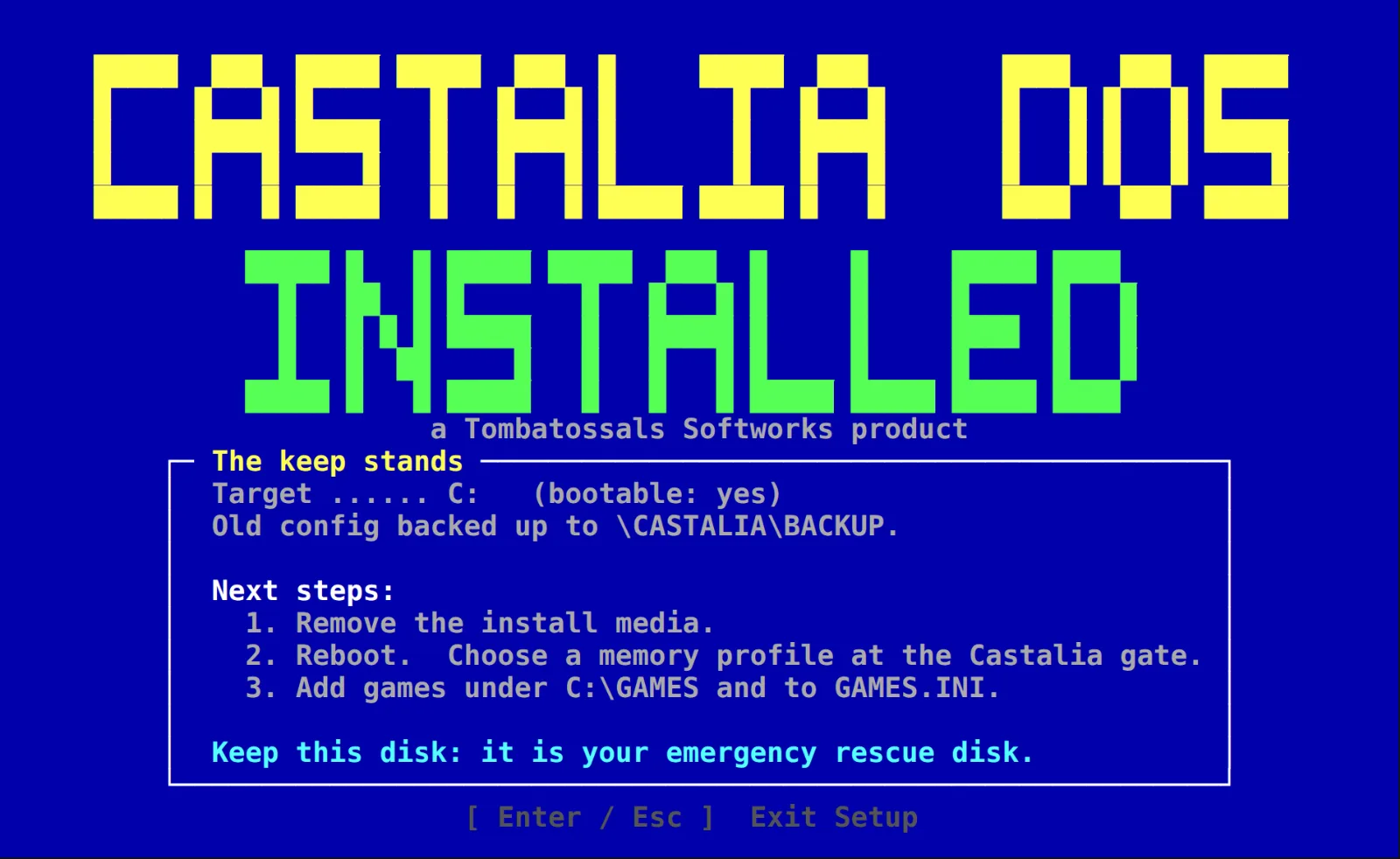
The design rule of Castalia DOS is brutal in its simplicity: when the machine powers on, it opens onto CASTALIA and nothing else. No «FreeDOS kernel», no «Open Watcom», no licence wall scrolling past. It sounded like changing three strings. It ended up being a kernel rebuild.
The problem: strings inside a packed image
The stock KERNEL.SYS prints its sign-on and a licence block unconditionally, from a compressed (UPX) image whose strings cannot be edited in place. A hex edit corrupts the checksum; unpacking and repacking by hand is hopelessly fragile. The only honest route was the front door: rebuild the kernel from its own published source, with a single marked change in the sign-on routine, and ship it uncompressed.
Legal by construction
FreeDOS explicitly permits this white-label step, and we do it in the open: its copyright and licence travel with the source the build gathers into third_party/, in the licence tree, and on the system’s own About screen. Honesty was non-negotiable: the banner says CASTALIA DOS, and the About says «Built on FreeDOS (GPLv2+)». Both are true.
It is a three-line change you can only make by recompiling two hundred thousand.
And on every commit, a disk boots
What keeps me up at night is not compiling a 1994 kernel with NASM and Open Watcom in 2026 — that, surprisingly, works first try if you respect the makefile. It is not breaking it afterwards. So CI assembles a bootable 1.44 MB floppy on every commit and actually boots it in a headless emulator, asserting it reaches AUTOEXEC.BAT from cold. A DOS that does not boot is not a DOS.
D. ABELLÁN · FOUNDER · PRINCETON, IL · 2026.07.05