CASTALIA-ONLY SIGN-ON
The FreeDOS kernel is rebuilt from source so its boot banner reads CASTALIA DOS 386SX Edition. No “FreeDOS kernel”, no “Open Watcom”, no scrolling licence wall.
CASTALIA DOS is a practical, beautiful, game-focused DOS-compatible operating environment for real 386 hardware. It is built on the FreeDOS kernel and shell and wraps them in an original suite of tools, eight boot profiles, a game launcher, an installer and a dignified 80×25 text-mode identity drawn from the stone fortresses of the Valencian coast.
There is no shortage of ways to run DOS in 2026. What there is a shortage of is a DOS that treats a 30-year-old machine as something worth dressing well. Most retro-DOS setups are a pile of drivers and a bare C:\> — functional, and completely anonymous. CASTALIA DOS starts from the opposite instinct: a real 386, booted on purpose, deserves a first-class, coherent, dignified face.
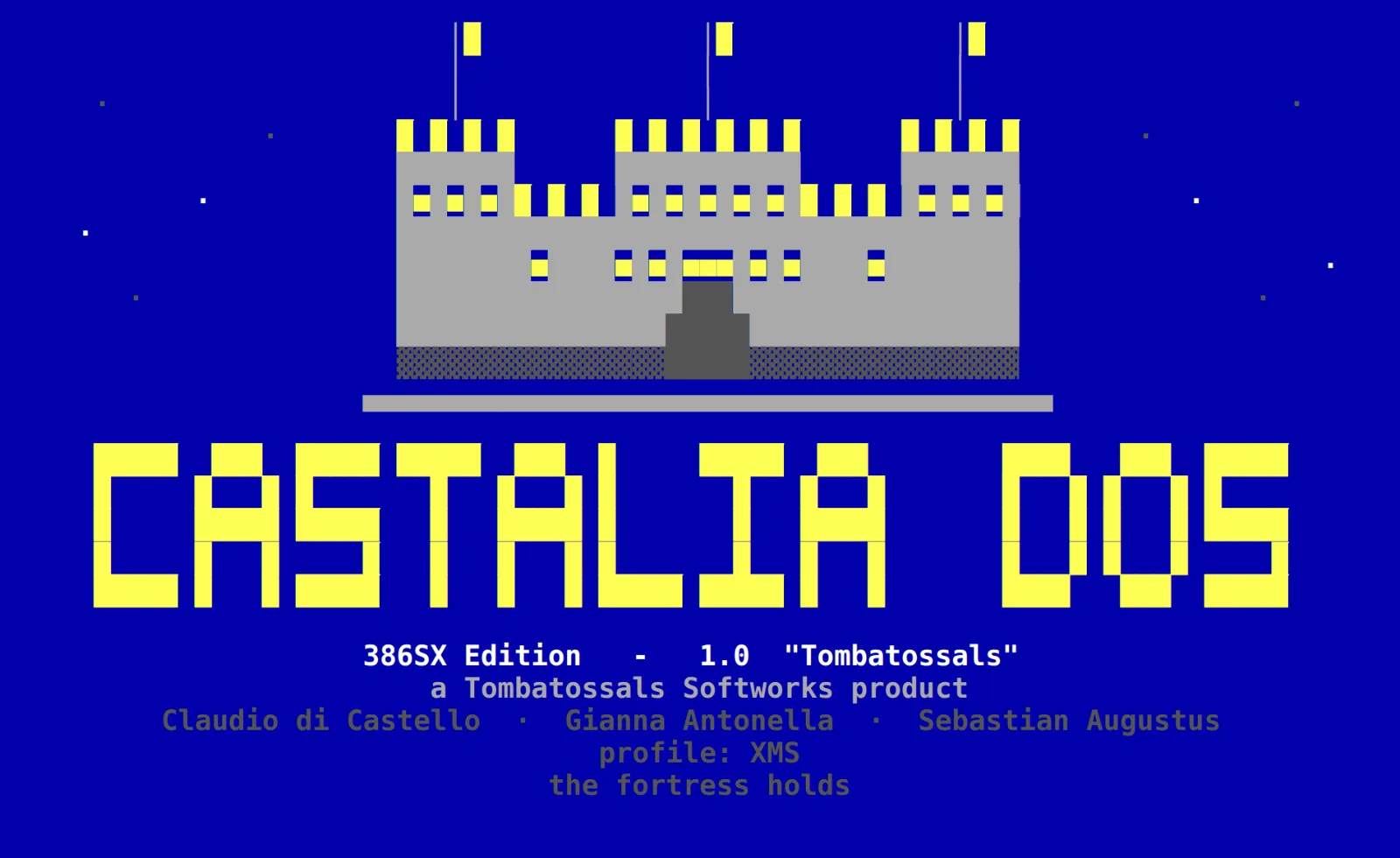
Its identity comes from the stone fortresses of Valencia and Castellón — Peñíscola on its sea-rock, Morella on its hill, the keep of Sagunto. When a Castalia machine powers on, the three-tower keep rises, the CASTALIA DOS wordmark lights amber, stars twinkle over a Mediterranean-blue field, and within about three seconds the menu is ready. Every screen — the boot banner, the rescue disk, the installer, the main menu — wears the same face.
And one rule governs everything else: compatibility beats elegance. When a choice must be made between a prettier design and a game that actually runs, the game wins. That is why the launcher unloads itself from memory before a game runs, and why there are eight memory profiles instead of one clever guess.
Someone decided a 386 deserved a fortress — and then built it. Legally, testably, and beautifully.
The FreeDOS kernel is rebuilt from source so its boot banner reads CASTALIA DOS 386SX Edition. No “FreeDOS kernel”, no “Open Watcom”, no scrolling licence wall.
An animated splash: a three-tower keep rises, the wordmark lights amber, the pennants and lit windows flicker like candlelight and stars twinkle over the Mediterranean-blue field. Any key skips it; it never blocks the boot.
A clean menu at boot: Maximum Compatibility, XMS Gaming (default), EMS Gaming, CD-ROM Gaming, Windows 3.x, Diagnostics, Safe Mode and a plain command prompt. Each tuned to the task.
The launcher (LAUNCH) and the menu unload from memory before a game runs, so the game gets every free byte. The elegance is in service of the machine, never the other way around.
MEMPROF, SETSOUND, HWINFO, CFGEDIT, SAFEBOOT, CASTFM, CASTDOC, CASTMARK, CASTEDIT, HELP… a full text-mode suite. Plus minigames: Snake, 15-Puzzle, Almena and Minas.
A SETUP wizard that never partitions or formats on its own, backs up any file it replaces and changes nothing until you confirm. The 1.44 MB floppy is both the installer and a self-contained emergency boot/rescue disk.
Calm, complete sentences; never blames the user, never shouts. “The drive is not ready. Insert a disk and press R to retry” — not “Not ready reading drive A. Abort, Retry, Fail?”.
Zero Microsoft material — no code, binaries, message text or branding. FreeDOS used under its own licence with source shipped, and the copyleft carefully contained.
Original Castalia programs run on top of an open-source DOS, talking to it only through the documented INT 21h interface. Nothing Castalia is linked into the kernel or shell.
The FreeDOS kernel (KERNEL.SYS) and FreeCOM (COMMAND.COM): a legal, open-source, MS-DOS-compatible DOS. On top: ~20 original 16-bit real-mode programs.
VGA 80×25, 16 colours, drawn by direct video-memory writes for speed on a 386SX; BIOS for the cursor and INT 16h for the keyboard.
The whole Castalia layer is real-mode C89, large model, no dynamic allocation: it compiles small and loads fast on period hardware. FAT12 on floppy, FAT16 on disk/CompactFlash.
C89 syntax check of every source, shell-script linting and repository sanity checks.
The real shared modules — INI parser, the boot-banner rebrand tool — compiled and executed natively.
All ~20 tools built for real with Open Watcom and verified as genuine DOS MZ executables; the FreeDOS kernel rebuilt with the CASTALIA sign-on.
A bootable 1.44 MB floppy image is assembled and actually booted in a headless emulator, asserting it reaches AUTOEXEC.BAT from cold.
The ~20 tools, the UI toolkit, the boot profiles, the installer and configuration.
The kernel and FreeCOM shell, memory managers and base utilities. The build fetches them from their upstream sources into third_party/; the design repo does not commit them.
No code, binaries, message text or branding. Lawfully redistributable worldwide, forever.
FreeDOS credited in the shipped source, in the licence tree and on the system’s own About screen.
No. CASTALIA DOS ships no Microsoft code, binaries, text or branding. It is FreeDOS plus original, MIT-licensed Castalia work. Any “MS-DOS 6.22-compatible behavior” wording is a plain description of behaviour, never a claim of origin.
Devlogs, patches and internal leaks. Zero spam, zero analytics. Just what matters, when it matters.